
The Whole Machine
Not a diagram — a living system. A brain in pure C, a pack of organs that punish every wrong move, and one architecture pointed at two completely different problems: reading a grid it has never seen, and owning a body it was never handed a controller for. Both feeds run below, off real recordings, losses included.
Watch It Learn
Not a highlight reel. Every run below is a full deterministic playthrough on a held-out board it never trained on — same seed, same frames, every time. Watch it cold-boot and stall, learn under the slap, then drive clean to the win. This is the whole arc, nothing cut.
Watch It Move
Same architecture, different problem. Nobody handed it a controller — it was dropped into a physics body with a pile of joints and had to work out what any of them were for. Left frame is NUMEN, right frame is the same body under random torque, same physics, same clock. No cuts, no speed-up, and the runs it lost are on the wall next to the ones it won.
The Organs
Negative feedback — a slap to the head
The brain doesn’t drive alone. Three organs ride the loop and punish it into learning. When a move loses ground — a wall bump, a step away from the goal, a wasted tick — the brain takes a negative callosum nudge, scaled by the dragon’s threat. A slap to the head that knocks it off the failing decode. That single mechanism took the move game from 43/100 to a perfect 100/100.
A real watchman compiled in C. It beats on the brain’s φ every tick and reports the field’s incoherence — how far it sits from the attractor. That threat decides how hard the slap lands.
The gate. Any move that already lost this episode is refused — the brain is forced to try something else instead of banging the same wall over and over.
Memory retrieval by φ-proximity. Shelves what worked at each world-state and resolves the current board to the nearest match — the organism recognising where it’s been.
Architecture Overview
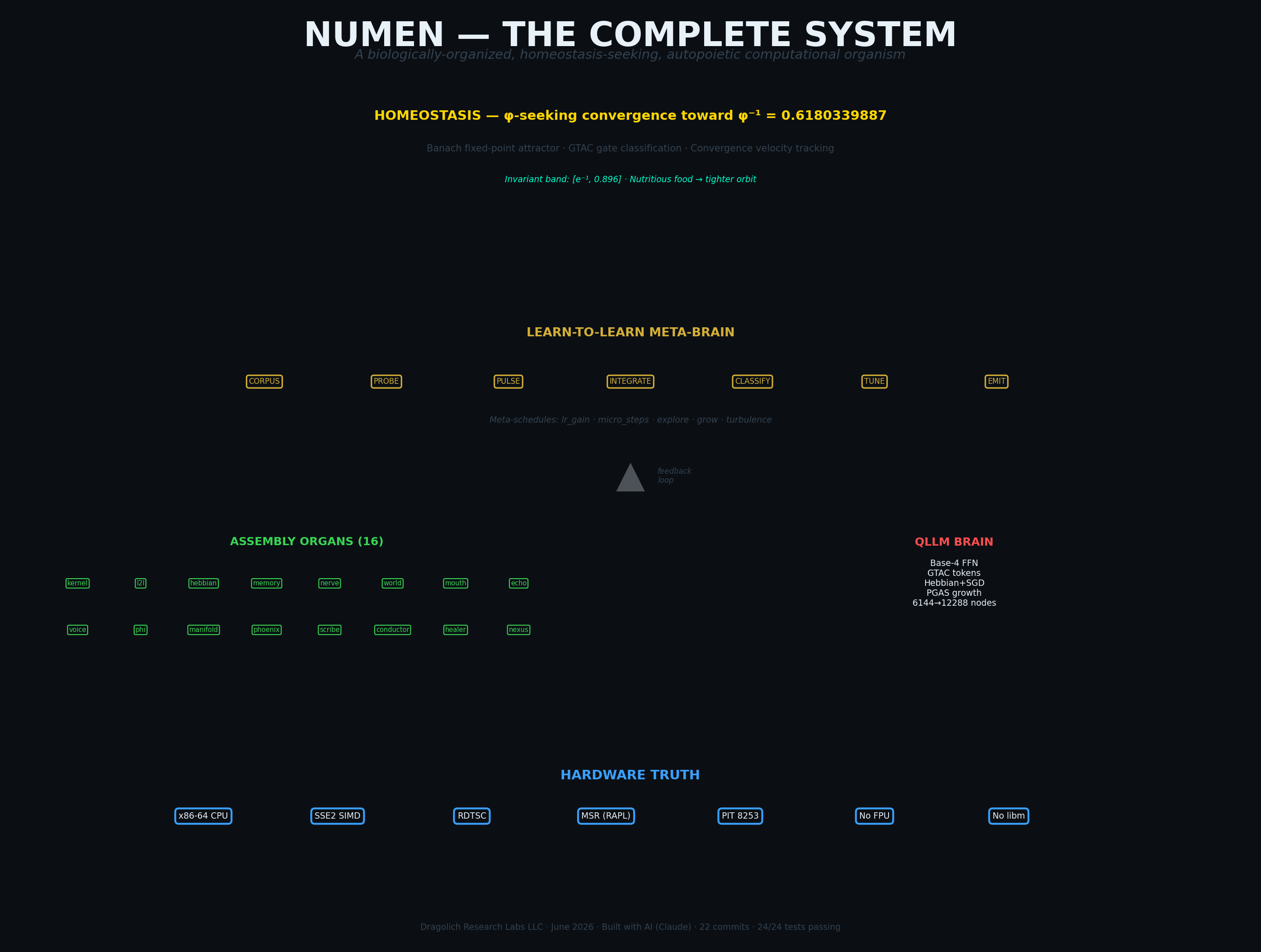
NUMEN OS operates as a unified cognitive field where every subsystem shares a common phi-space addressing system. Every operation, every decision, every memory is tagged with a phi-address and measured by CGOS 6D. That is the design, and it is the same design running underneath both feeds above.
The bilateral coupling mechanism mirrors operations in one hemisphere into the other and verifies them against each other — a self-checking loop. The 2,558,850+ cycle figure quoted below comes from the C core's own internal counter during a long instrumentation run on the workstation; it is not something the two feeds on this page measure, and we label it that way on purpose.
CGOS 6D
Coherence-Gated Operating System
C = (π × φ × Ωn × τ × ψ × β)1/6 → φ⁻¹
The master formula. Six dimensions. One convergence target.
How essential is this operation to the current goal?
Resource cost vs. cognitive gain ratio. Measured against φ⁻¹ baseline.
Information-theoretic complexity of the operation. Shannon entropy derivative.
Temporal coherence. Is this the right moment for this operation?
Can this operation be grouped with related operations for efficiency?
Expected downstream value. Weighted by historical convergence data.
Gate States
Forward propagation. All dimensions above threshold. Commit the cognitive operation.
Backtrack. Efficiency dropped below φ⁻¹ floor. Re-route through alternative pathway.
Hold state. Insufficient information for decision. Buffer until convergence signal.
Cross-lateral transfer. Bilateral coupling detected. Route to contralateral hemisphere.
ReL Language
Recursive Emergence Language
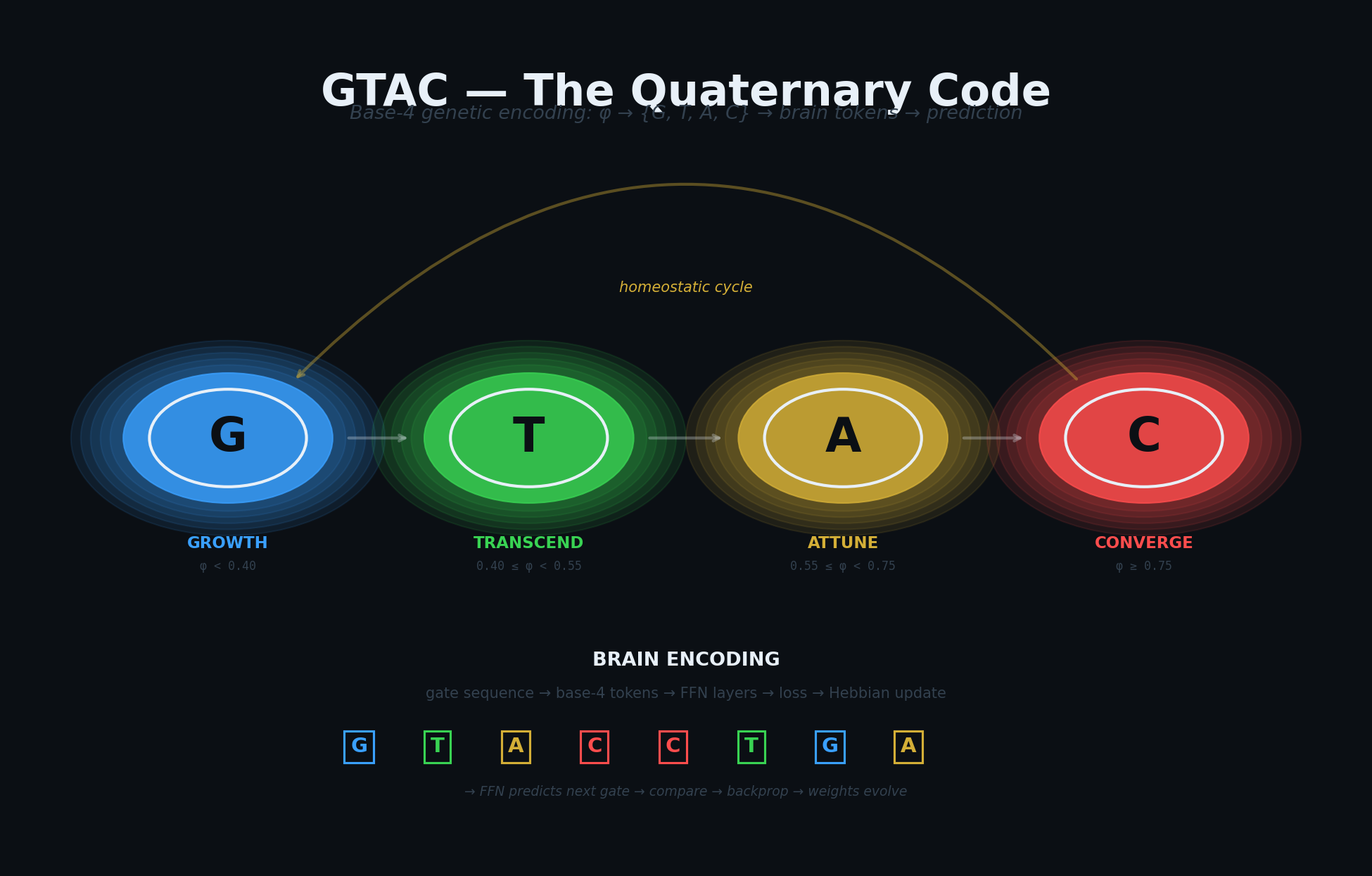
ReL is not a programming language. It is a cognitive encoding — a way of representing thought itself. Every concept is a love-pair: two complementary perspectives that collapse into meaning through phi-mediated resonance.
Glyph encoding (⨀⨋⊙) provides lossless thought compression. The alpha resonance at 1/137 — matching the fine-structure constant — ensures coherent propagation across cognitive layers.
Design constants — not benchmark results
Cache Speedup
Alpha Resonance
Glyph System
// ReL love-pair example
pair: coherence ↔ measurement
glyph: ⨀(c, m)
phi_addr: 0.618033
resonance: 1/137
UOD Oracle
Universal Oracle Decoder
Every decision NUMEN makes passes through the UOD. The Oracle routes decisions toward φ⁻¹ convergence, applying a threshold of < 0.01 deviation. When a decision path diverges beyond threshold, the Oracle reroutes through BACK gate, preserving system coherence.
The Oracle doesn’t predict outcomes. It measures the phi-distance of every possible path and selects the one closest to golden convergence. This is decision-making as geometry.
Learn-to-Learn Engine
Self-Improving Tool Harvest
The L2L Engine harvests capabilities from 36 source modules through a 4-phase cycle: discover new tools → test against phi-convergence criteria → integrate into active skill set → verify through bilateral coupling.
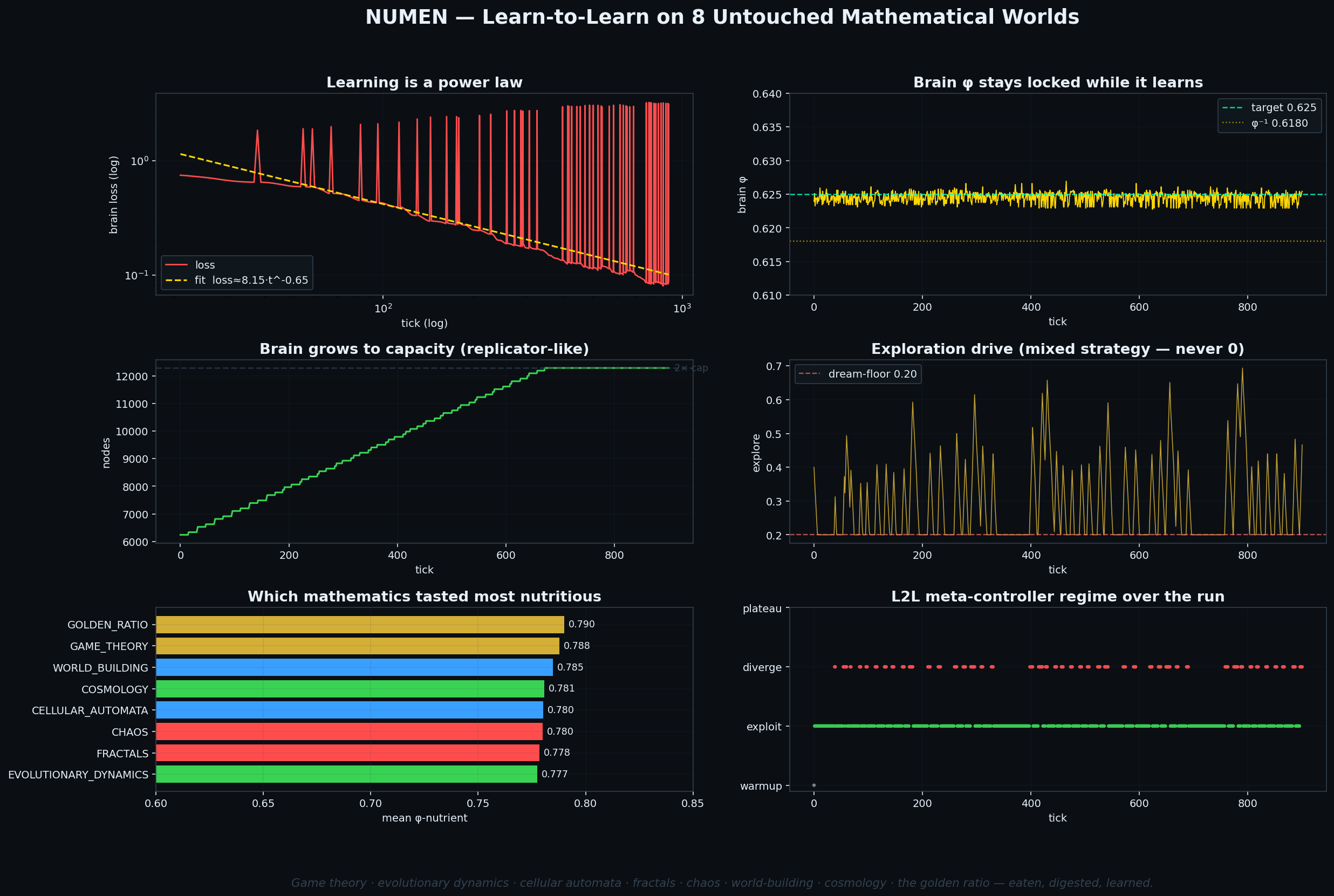
L2L measured across 8 untouched mathematical worlds — phi locked at 0.625
Phi-Space
σ-Prime Addressing & Bilateral Coupling
Every piece of information in NUMEN has a phi-address — a coordinate in phi-space derived from SIGMA_PRIMES indexing. The phi_to_idx function maps continuous phi-values to discrete memory locations, enabling O(1) lookup across the entire cognitive field.
Bilateral coupling creates mirror-state verification. The C core's internal counter logged 2,558,850+ cycles of left-right hemisphere synchronization with zero reported drift across a 60+ day continuous run on the workstation. That is the core's self-report from its own instrumentation — read it as an engineering log line, not as an independently audited benchmark.
// Phi-Space addressing
sigma_idx = phi_to_idx(0.618033, SIGMA_PRIMES)
bilateral_state = couple(left_hem, right_hem)
cycles: 2,558,850+ | drift: 0.000 // core self-report
What On This Page Is Measured, And What Isn't
Every page on this site is supposed to survive somebody asking “prove it.” So here is the split, in plain language, for this page specifically.
- — Feed 01: 25 grid-game reels, each a full deterministic playthrough stored as a static file under /reels. Nothing is regenerated in your browser.
- — Feed 02: 8 physics rollouts recorded as video, each paired with the same body under random torque. Scores come from the recorded episode return.
- — The losses. The ant jump run is worse than random and it is on the page anyway.
- — CGOS 6D, the gate states, the UOD Oracle and phi-space addressing describe how the core is built. They are design, not scores.
- — The 17× cache figure and the 1/137 resonance constant are internal design targets from the C core, not third-party measurements.
- — The 2,558,850+ cycle / 60+ day figures are the core's own log output from the workstation, not an audited uptime claim.
If a number on this site ever turns out to be wrong, the fix is to correct it in public, not to quietly delete the page. That rule is the only reason any of the rest of it is worth reading.